
 Jul 8
Jul 8
Beck
Singer | 56 yrs
Cancer
Read more
YouTube and Wikipedia entries are pulled live from public feeds; Facebook posts load from Facebook's own embed. Lines marked teaser are written summaries, not real posts.
Politician
| Born | Nelson Aldrich Rockefeller, July 8, 1908, Bar Harbor, Maine, U.S. |
|---|---|
| Died | January 26, 1979 (aged 70), New York City, U.S. |
| Spouses | Mary Todhunter Clark, (m. 1930; div. 1962), Margaretta Large "Happy" Fitler, (m. 1963) |
| President | Gerald Ford; Dwight D. Eisenhower; Franklin D. Roosevelt, Harry S. Truman |
| Preceded by | Gerald Ford; W. Averell Harriman; Position established |
| Succeeded by | Walter Mondale; Malcolm Wilson; Herold Christian Hunt; Spruille Braden |
| Lieutenant | Malcolm Wilson |
| Resting place | Rockefeller Family Cemetery, Sleepy Hollow, New York, U.S. |
| Party | Republican |
| Children | 7, including Rodman, Ann, Steven, Michael, and Mark |
| Parents | John D. Rockefeller Jr., Abby Aldrich |
| Relatives | Rockefeller family |
| Education | Dartmouth College (AB) |
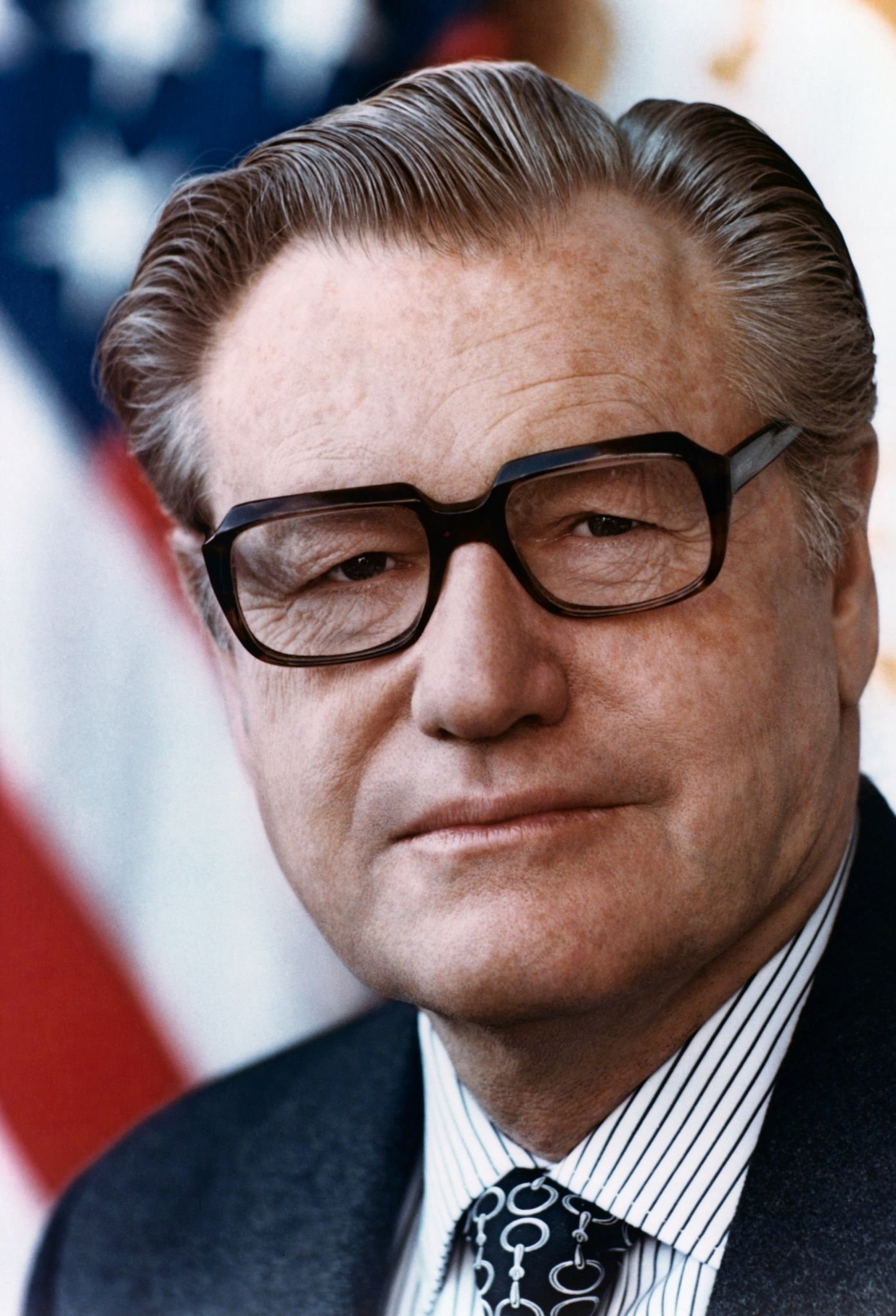
Nelson Aldrich Rockefeller (July 8, 1908 – January 26, 1979) was the 41st vice president of the United States, serving from 1974 to 1977 under President Gerald Ford. A member of the Republican Party and the wealthy Rockefeller family, he was the 49th governor of New York from 1959 to 1973. He was the leader of the moderate faction of his party, known as the Rockefeller Republicans.
This profile of Nelson Rockefeller covers Early Life and Family Background, Early Career and Breakthrough, Coordinator of Inter-American Affairs (CIAA), Assistant Secretary of State for American Republic Affairs and International Basic Economy Corporation (IBEC).
After graduating from Dartmouth College in 1930, Rockefeller worked at various businesses connected to his family. He served as Assistant Secretary of State for American Republic Affairs for presidents Franklin D. Roosevelt and Harry S. Truman (1944–1945), and as Undersecretary of Health, Education and Welfare (HEW) under Dwight D. Eisenhower from 1953 to 1954. He was first elected governor of New York in 1958, and was re-elected in 1962, 1966, and 1970. As governor of New York, Rockefeller's achievements included the expansion of the State University of New York (SUNY), efforts to protect the environment, the construction of the Empire State Plaza in Albany, increased facilities and personnel for medical care, and the creation of the New York State Council on the Arts. Rockefeller was often considered to be liberal, progressive, or moderate. In an agreement that was termed the Treaty of Fifth Avenue, he persuaded Richard Nixon to alter the Republican Party platform just before the 1960 Republican National Convention.
After unsuccessfully seeking the Republican presidential nomination in 1960, 1964, and 1968, Rockefeller was appointed vice president of the United States by President Gerald Ford in December 1974. Rockefeller was the second vice president appointed to the position under the 25th Amendment, following Ford himself. Rockefeller did not seek a full term in the 1976 election with Ford, who named Kansas senator Bob Dole as his running mate instead of Rockefeller that year. Rockefeller retired from politics in 1977 and died two years later from a heart attack.
As a businessman, Rockefeller was president and later chair of Rockefeller Center, Inc. He also formed the International Basic Economy Corporation in 1947. Rockefeller assembled a significant art collection and promoted public access to the arts. He served as trustee, treasurer, and president of the Museum of Modern Art and founded the Museum of Primitive Art in 1954. In the area of philanthropy, he founded the Rockefeller Brothers Fund in 1940 with his four brothers and established the American International Association for Economic and Social Development in 1946.
Nelson Aldrich Rockefeller was born on July 8, 1908, in Bar Harbor, Maine. Named Nelson Aldrich after his maternal grandfather Nelson W. Aldrich, he was the second son and third child of financier and philanthropist John Davison Rockefeller Jr. And philanthropist and socialite Abigail "Abby" Aldrich. He had two older siblings—Abby and John III—as well as three younger brothers: Laurance, Winthrop, and David. His father, John Jr., was the only son of Standard Oil co-founder John D. Rockefeller and schoolteacher Laura Spelman. His mother, Abby, was a daughter of Senator Nelson Wilmarth Aldrich and Abigail P. Greene.
Rockefeller grew up in his family's homes in New York City (mainly at 10 West 54th Street), a country home in Pocantico Hills, New York, and a summer home in Seal Harbor, Maine. The family also travelled widely. He received his elementary, middle, and high school education at the Lincoln School in Manhattan, an experimental school administered by Teachers College of Columbia University and funded by the Rockefeller family. Rockefeller was known to disappear on the way to school and was once found exploring the city's sewer system. As a child, he was the "indisputable leader" of his brothers, becoming particularly close to Laurance.
Although his parents saw the potential for Rockefeller to succeed in life, he was a poor student. Generally in the lower third of his class, he almost failed ninth grade and had undiagnosed dyslexia. Biographer Joseph E. Persico wrote that as a child, Rockefeller "demonstrated a discipline that throughout life would serve him in lieu of brilliance". Although Rockefeller was not accepted into Princeton University, he gained admission to Dartmouth College, arriving on campus in 1926. While in college, he met Mary Todhunter Clark at the summer home in Maine, and the two fell in love. They were engaged in autumn 1929. In 1930, he graduated cum laude with an A.B. Degree in economics from Dartmouth, where he was a member of Casque and Gauntlet (a senior society), Phi Beta Kappa, and Psi Upsilon. Rockefeller and Mary were married after he graduated, on June 23, 1930, at Bala Cynwyd, Pennsylvania.
Following his graduation, Rockefeller worked in several family-related businesses, including Chase National Bank; Rockefeller Center, Inc., joining the board of directors in 1931, serving as president, 1938–1945 and 1948–1951, and as chairman, 1945–1953 and 1956–1958; and Creole Petroleum Corporation, the Venezuelan subsidiary of Standard Oil of New Jersey, 1935–1940. Rockefeller served as a member of the Westchester County Board of Health from 1933 to 1953. His service with Creole Petroleum led to his deep, lifelong interest in Latin America and he became fluent in the Spanish language.
In 1940, after he expressed his concern to President Franklin D. Roosevelt over Nazi influence in Latin America, the President appointed Rockefeller to the new position of Coordinator of Inter-American Affairs (CIAA) in the Office of the Coordinator of Inter-American Affairs (OCIAA). Rockefeller was charged with overseeing a program of U.S. Cooperation with the nations of Latin America to help raise the standard of living, to achieve better relations among the nations of the western hemisphere, and to counter rising Nazi influence in the region. He facilitated this form of cultural diplomacy by collaborating with the director of Latin American Relations at the CBS radio network Edmund A. Chester.
The Roosevelt administration encouraged Hollywood to produce films to encourage positive relations with Latin America. Rockefeller required changes in the movie Down Argentine Way (1940) because it was considered offensive to Argentines. It was much more popular in the United States than in Latin America. Charlie Chaplin's satirical The Great Dictator (1940) was banned in several countries.
In the spring of 1943, Rockefeller supported extensive negotiations and the mission of North American members of the Junior Chamber of Commerce to Latin America as Coordinator of Inter-American Affairs of the U.S. State Department, establishing the Junior Chamber International after its first Inter-American Congress in December 1944 at Mexico City. After coming back from the Inter-American Congress, Rockefeller convinced his father, John D. Rockefeller Jr., to donate the land to the city of New York to build the foundations of what would later become the United Nations Headquarters.
Source: adapted from Wikipedia (https://en.wikipedia.org/wiki/Nelson_Rockefeller), text available under CC BY-SA 4.0.
Jul 8
Singer | 56 yrs
Cancer
Read more Jul 8
Jul 8
Notable person | 132 yrs
Cancer
Read more Jul 8
Jul 8
Actor | 91 yrs
Cancer
Read more Jul 8
Jul 8
Notable person | 159 yrs
Cancer
Read more Jul 8
Jul 8
Actress | 109 yrs
Cancer
Read more Jul 8
Jul 8
Tennis Player | 27 yrs
Cancer
Read more Jul 8
Jul 8
Actress | 75 yrs
Cancer
Read more Jul 8
Jul 8
Actress | 28 yrs
Cancer
Read more Jul 8
Jul 8
Footballer | 85 yrs
Cancer
Read more Jul 8
Jul 8
Author | 116 yrs
Cancer
Read more Jul 8
Jul 8
Actress | 53 yrs
Cancer
Read more Jul 8
Jul 8
Footballer | 74 yrs
Cancer
Read more